

To play it safe
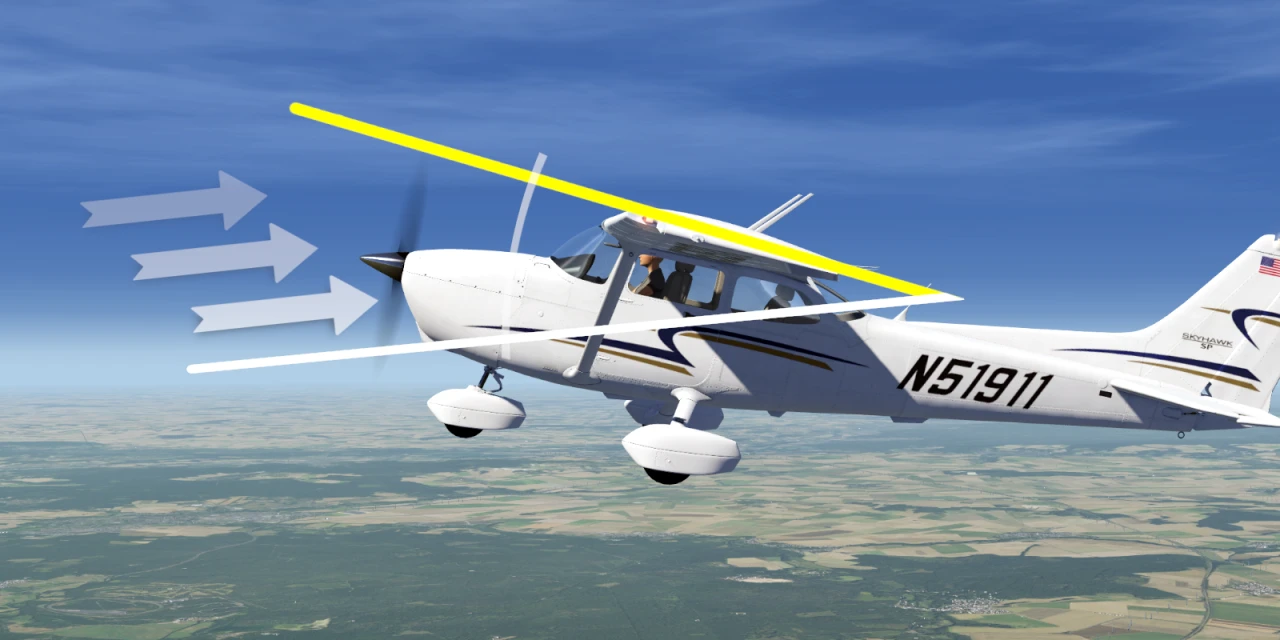
In flying, what matters is the controlled management of forces, speed — and here in particular — the adherence to safety margins. If you understand what is happening aerodynamically, you will be better prepared in critical situations. In Aerofly FS, you can train all performance limits without risk, allowing you to react more calmly and precisely in an actual emergency.
The angle of attack: invisible, but critical
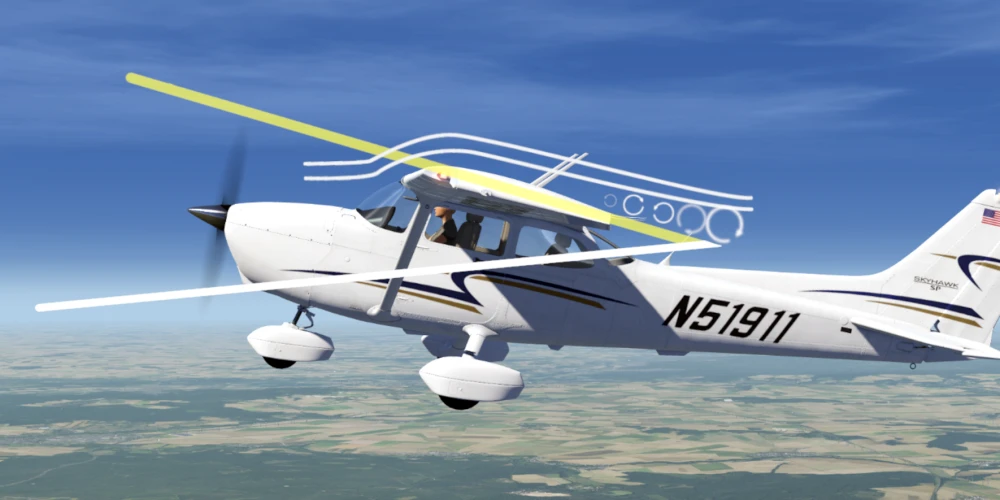
The angle of attack is, first of all, simply the angle between the wing’s chord line and the oncoming airflow. It is a key factor in determining how much lift a wing generates. As the angle of attack increases, lift initially increases as well.
However, this relationship only holds up to a certain point: the critical angle of attack. Once this is exceeded, the airflow separates from the wing surface, resulting in a stall. At that moment, lift effectively collapses. What can be a bit tricky to understand is that a stall is not simply caused by dropping below a certain airspeed, but primarily by exceeding the critical angle of attack.
It is important to understand that the oncoming airflow does not always strike the wing profile exactly head-on. When entering a vertical air movement, the effective angle of attack changes temporarily, even though your aircraft maintains the same attitude relative to the horizon. In an unfavourable case, this can bring you close to the edge of a stall. Your goal is therefore to keep the angle of attack at all times within a safe range in which the airflow remains firmly attached and sufficient lift is generated.
The green area
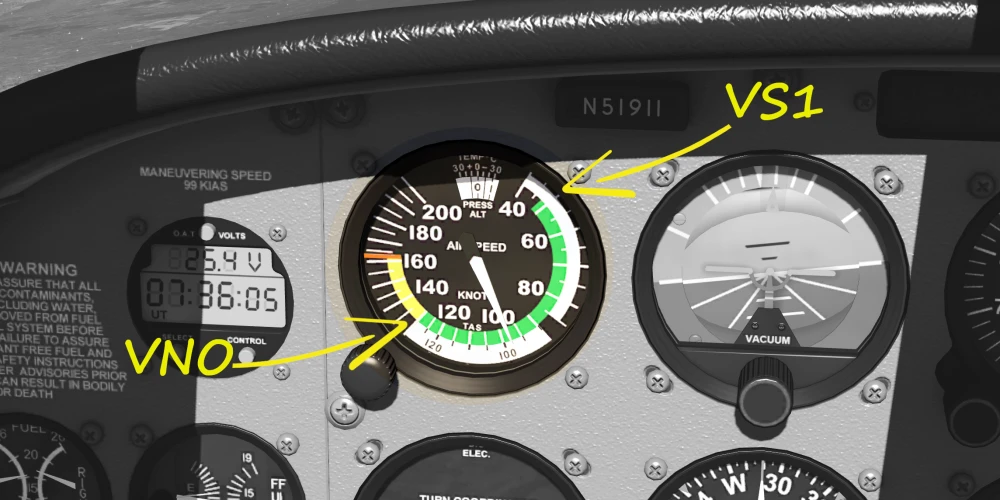
Your most important instrument for staying within the safe range is first and foremost the airspeed indicator. Even though airspeed is only an indirect indicator, you are generally safe when operating within the green arc of the scale. This range extends from VS1 (stall speed in unaccelerated straight flight without flaps) up to VNO (maximum structural cruising speed). In the yellow marked range, you should only fly in smooth air.
From all these relationships, your safety margin is derived: a moderate angle of attack with sufficient airspeed reserve gives you room for corrections before a stall becomes a risk. Even during flight phases such as turns, climbs, or descents, the effective angle of attack is constantly changing. Flying continuously near the stall limit during these manoeuvres would be far too risky.
Speed equals safety
With a margin above the minimum airspeed, you have greater aerodynamic stability and gain additional reaction time in unexpected flight conditions such as turbulence. Therefore, always monitor your airspeed and also keep an eye on the perceptible angle of attack in order to recognise early when your aerodynamic reserve is decreasing.
Speed on top for turning flight
In contrast to unaccelerated level flight from the previous tutorial, turning flight is a flight condition in which additional forces act on the aircraft. When initiating a turn, the aileron on the outside of the turn is deflected downward, which increases lift on that wing. This aileron deflection effectively changes the wing’s camber and thereby increases the local angle of attack. This can — especially at low airspeeds — cause the airflow on that wing to approach the critical range, including the risk of an abrupt stall or wing drop.
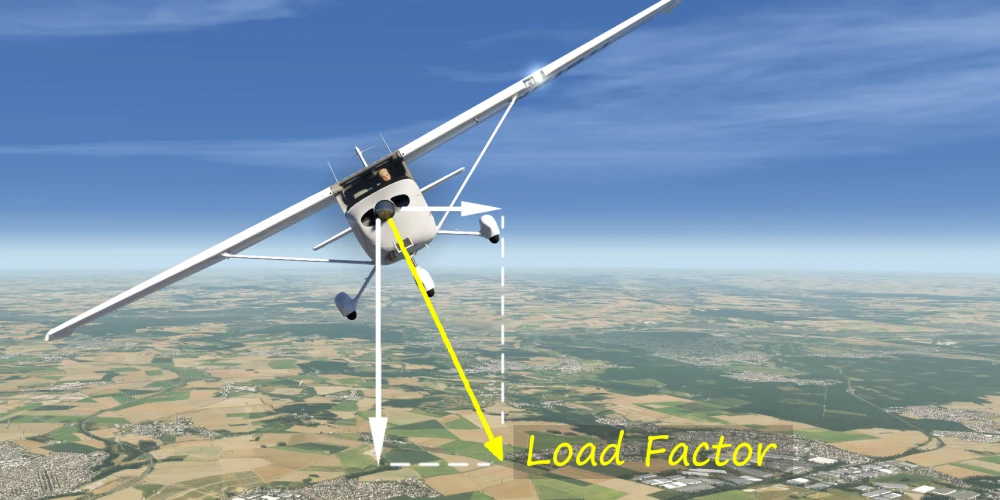
The bank angle in a turn also increases the load factor, and with it the amount of lift required to maintain altitude. Since additional lift can only be generated by increasing the angle of attack, you move closer to the critical limit again. This is why you need extra airspeed to safely enter a turn.
As the bank angle increases, your stall speed also rises noticeably. In a standard turn with a 30° bank, this is roughly about 10% more speed. At 40° of bank, you already need around 20% more. These values are only rough guidelines and not binding, but the key point to remember is: the tighter the turn, the greater your required speed margin.

The little extra for the approach
In the approach to landing, the same principle applies: speed equals safety. Near the ground, turbulence, wind shear, or gusts can have much more noticeable effects than at higher altitudes. A small speed margin above the calculated approach speed also gives you an important safety buffer here.
On final approach, you are flying close to the ground, often with a higher angle of attack due to deployed flaps and in a phase with limited power reserve. A particularly critical situation can be a sudden drop in indicated airspeed (IAS). Lift decreases, the aircraft sinks slightly, and you may instinctively pull back on the elevator.
Now, however, the angle of attack increases, and you once again approach the critical limit. In gusty conditions, you therefore need to add a speed increment to the normal approach speed. The exact value depends on your aircraft type.
This extra speed is not maintained all the way to touchdown; instead, it is gradually reduced during the flare just above the ground. How this is done precisely will be covered in the next tutorial.