

Unaccelerated level flight
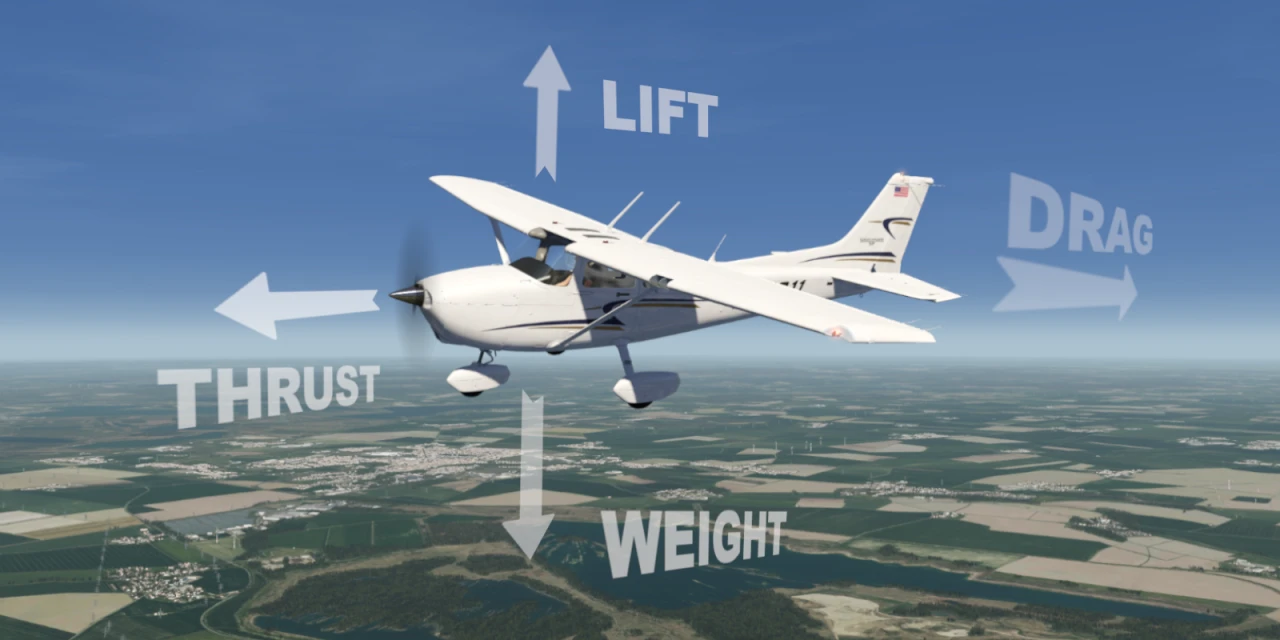
Flying straight and level may seem simple at first, but this phase is a key part of your pilot training. In level flight, all forces are in balance: lift and weight cancel each other out, just as thrust and drag do. Airspeed remains constant, and ideally so does altitude. This is exactly why this state is the foundation of smooth flying and of any controlled transition into a climb or descent. Unaccelerated level flight is the stable baseline for every controlled flight condition.
A crucial point here is trimming. As a beginner, you might see it as a mere comfort feature, but in reality it is an important control tool. Properly trimmed means that the aircraft maintains the desired attitude and airspeed on its own, without you having to continuously pull or push the control stick. Without correct trim, small but constant deviations occur, which can quickly develop into speed or altitude errors and unnecessarily distract your attention.

First, maintain altitude precisely.
To establish stable level flight, you first set the correct attitude. The real or artificial horizon serves as your primary reference. When the horizon is positioned near the center, you apply an appropriate power setting at which the aircraft maintains its airspeed—for example, 100 knots.
Once the power is correctly set, you will notice that you continuously need to apply slight forward pressure to prevent the aircraft from climbing further. This is the moment to trim nose-down until no control pressure is felt anymore. Only when the aircraft maintains both airspeed and altitude stably without active control input has true level flight been achieved. In a Cessna, the power setting for this speed will be approximately 75%. From this stable condition, you can now initiate two controlled transitions: climb and descent.
Up to the sky
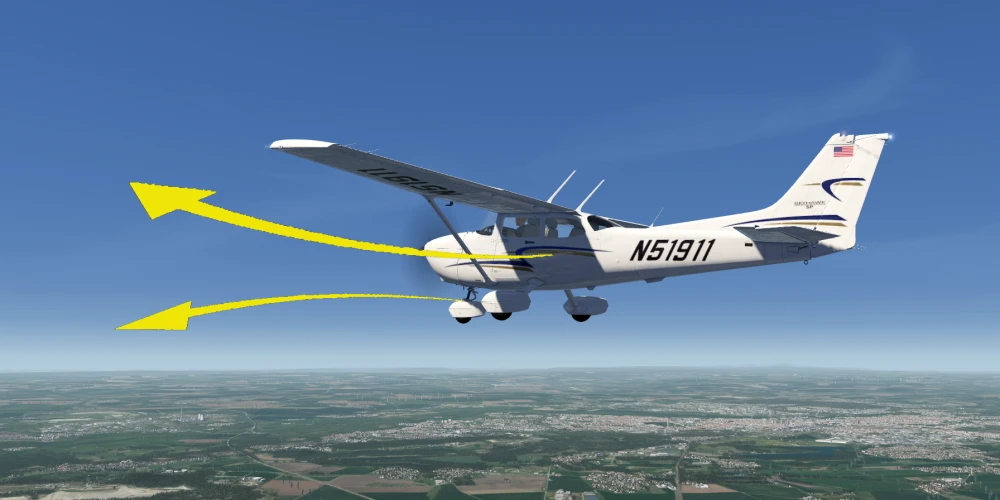
For the climb, you first need additional energy, so to initiate the climb you increase power. This provides more thrust than would be required for level flight. After increasing power, the aircraft begins to accelerate. As the speed starts to increase, you raise the nose.
At this stage, focus primarily on airspeed and find the speed at which the aircraft neither continues to accelerate nor constantly loses speed. Once you have achieved this, you can briefly check the vertical speed indicator—it will show a stable value. This is the rate of climb your aircraft can achieve at this power setting. You can now trim again for this condition. If everything is set correctly, the aircraft will climb in trim and within its limits, without entering a critical flight regime.

How do I get down again
The transition into a descent works in essentially the same way — just in the opposite direction. You first reduce power slightly, which will cause the airspeed to decrease. As the speed drops, you lower the nose slightly to maintain a constant airspeed. Altitude is now gradually reduced in a controlled manner. Once both airspeed and descent rate have stabilised, you trim again. The result is a smooth, steady descent without changes in speed.
The most important point when initiating a climb or descent is to always think about engine power first, and only then adjust the flight attitude. Through power setting, you influence the available energy and determine how that energy is used—whether it is converted into speed or altitude.
Once you have internalised these relationships in training aircraft, it will be easier for you to transition to larger and more sluggish aircraft types and to interpret their behaviour much more effectively. On your path to becoming an airliner pilot, you have now taken a big step forward!