

Stream – Drag – Lift
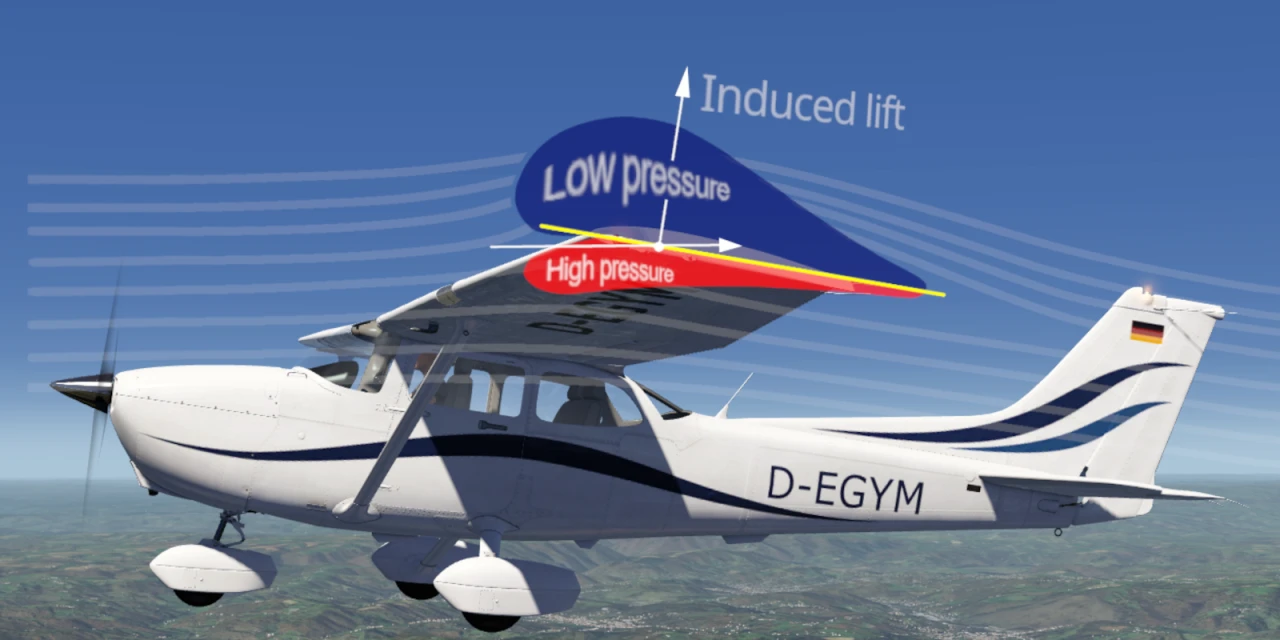
For an airplane to fly, it must move relative to the air. In our Cessna, the engine and propeller provide the speed relative to the air, while the angle of attack of the wing generates lift. This is a highly simplified introduction to a rather complex subject, but in these beginner tutorials we want to keep things straightforward.
The surrounding air meets our aircraft from the front, generates lift, and raises it up. The faster we fly, the more lift is available to us. So there are “invisible” forces at work that overcome the mass of the aircraft. However, it’s not quite as simple as shown in the picture, because the lift forces first have to be generated. And like many forces, they unfortunately come with side effects that we need to overcome and understand in order to fly.

Lift is not for free
An aircraft’s wing has a characteristic shape. The upper surface of the airfoil is usually curved, while the lower surface is flatter. In addition, the wing is not aligned exactly parallel to the oncoming airflow, but is slightly tilted with its leading edge upward—more precisely, it has an angle of attack. This combination of airfoil shape and angle of attack ensures that the incoming air is influenced in a controlled way.
The airfoil forces the airflow to change its path. Part of the air is displaced upward, while another part is deflected downward. This division of the incoming airflow creates a difference in pressure distribution. Above the wing, the pressure is lower than on the underside. This pressure difference essentially constitutes lift and is a direct result of the deflection of the airflow. It’s important to understand that lift, as a result of this forced redirection of the flow, is not generated “for free.” The price for it is drag. We must apply a continuous force to move the aircraft through the air in order to generate lift.
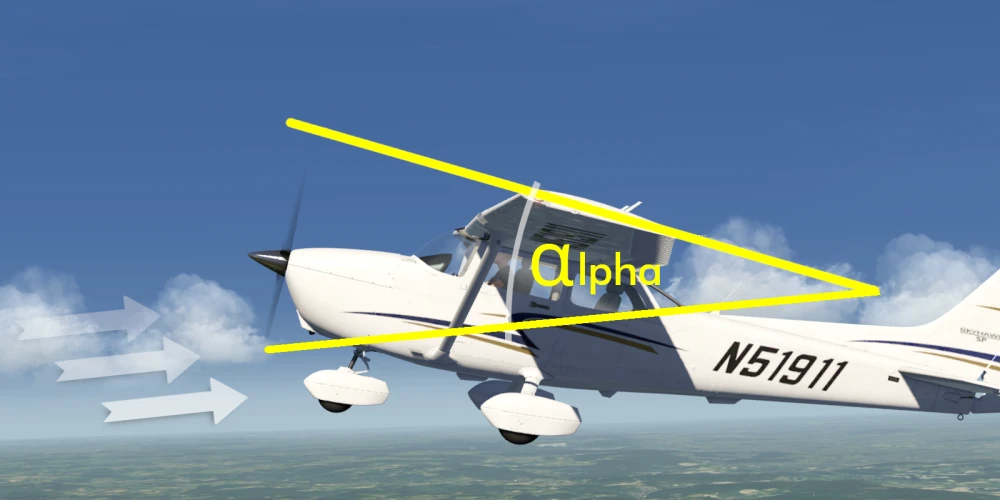
A lot turns around the angle of attack
The angle of attack describes the angle between the oncoming airflow and the wing — more precisely, the chord line of the airfoil. It is one of the most important parameters in an aircraft’s aerodynamics. Increasing the angle of attack causes the incoming air to be deflected more strongly, which increases lift.
Conversely, a smaller angle of attack leads to less deflection of the air and therefore less lift. While increased lift from a higher angle of attack may sound appealing, this approach has its limits. If the angle of attack becomes too large, the airflow begins to separate from the surface. The result is a sudden loss of lift, known as a stall. In aircraft design, this condition is typically taken into account: the stall is usually preceded by warning signs such as vibrations or a “mushy” control feel, and it generally begins at the wing root so that the ailerons remain effective at first.