

Takeoff: full throttle and nose up?
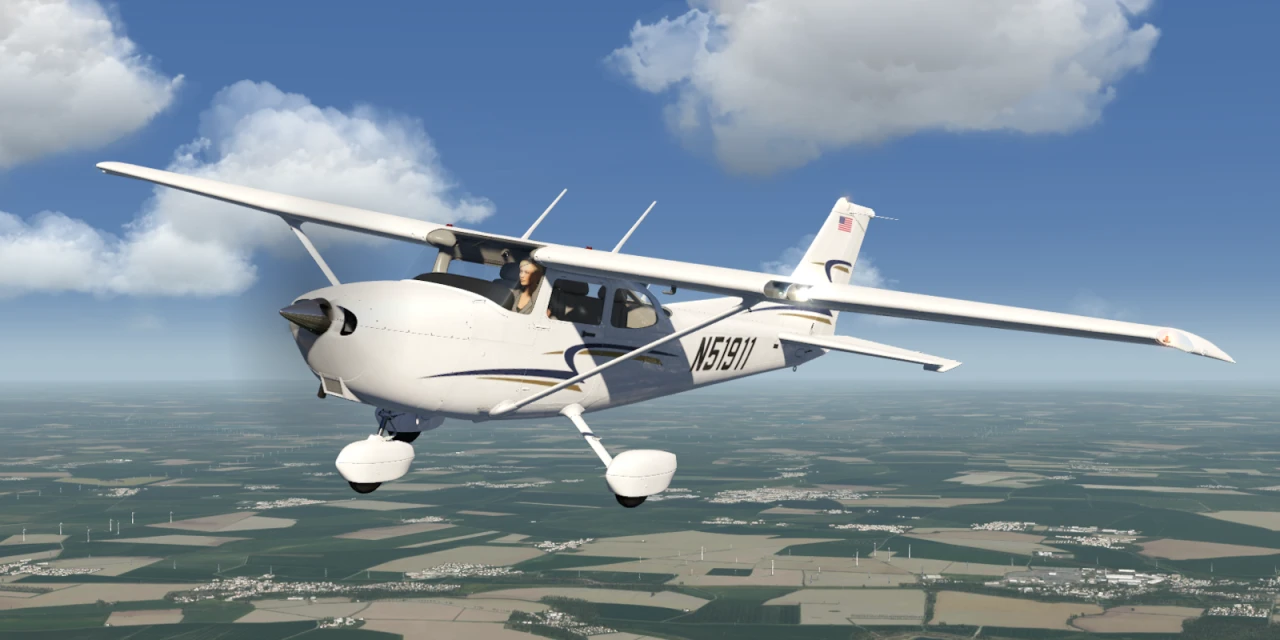
Takeoff and the subsequent climb are not just the random result of adding power and pulling back on the elevator, but rather a coordinated interaction of speed, power, and aircraft attitude.
In reality, takeoff is one of the more demanding phases of flight because several factors come together in a short period of time. In the previous tutorials, we learned that engine power, speed, and angle of attack all influence each other—and this also applies to takeoff. To accelerate the aircraft, you first need thrust, so you increase engine power, which allows the propeller to generate more thrust.
As speed increases, the air flows faster and faster over the wings and begins to generate more and more lift. At a certain speed, lift can exceed the force of gravity. From that point on, you could theoretically fly — but in practice, we need to remember that lift always comes at the cost of drag. If you pull back on the elevator too early, you do increase lift, but you also immediately increase drag and risk losing speed again. The first goal, therefore, is to reach the appropriate rotation speed, usually referred to as “Vr.”
Vr is therefore the speed at which you have sufficient airspeed margin to gently pull back on the elevator, increase the angle of attack, and lift off. For the Cessna 172, the rotation speed — depending on weight and other conditions—is approximately 55 knots. You should actually initiate the “rotation,” meaning raising the nose, as soon as Vr is reached, because if you continue rolling down the runway unnecessarily, you waste valuable runway length. From the moment Vr is reached, altitude above ground always means increased safety.
You’re flying - but still very close to the ground!
Rolling along the runway at increasing speed was the first exercise, but after liftoff things get serious. From this point on, the task is to find an efficient balance between climbing without losing too much airspeed. For the climb, you therefore increase the angle of attack only as much as necessary to generate sufficient lift, without dropping into a critical speed range.
An angle of attack that is too high can — regardless of engine power — lead to a sudden stall. That’s why the nose is always raised in a controlled and gradual manner, not abruptly. So don’t get too excited after liftoff; from now on, the main focus is to keep an eye on airspeed.
Fortunately, the aircraft manual also specifies a particular climb speed for this phase: Vy. This speed represents the best rate of climb, meaning the greatest gain in altitude per unit of time. For a Cessna 172, Vy is typically around 75 knots, depending on the specific variant and loading.
Control your focus
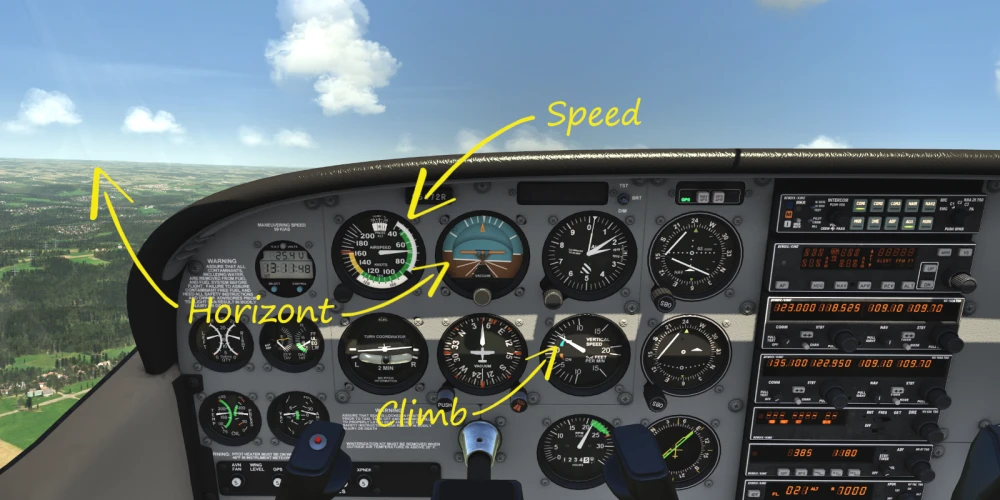
Try it in Aerofly FS: if you climb more steeply, you won’t be able to maintain your Vy speed, and in the end you’ll see a lower rate of climb on the vertical speed indicator than with the prescribed climb speed. Your most important control in this phase is therefore also the elevator: it is what you use to control the angle of attack, and consequently both the climb and the airspeed. However, don’t focus only on the airspeed indicator, and don’t try to correct every small deviation in a hectic way. At the same time, keep an eye on the vertical speed indicator and the horizon in front of you. Develop a feel for maintaining a steady flight attitude and make only small, smooth corrections.
In summary, takeoff is not an abrupt pull on the control stick, but a structured sequence. First, power is applied and the aircraft accelerates. Then, upon reaching rotation speed, the nose is raised in a controlled manner. After liftoff, the angle of attack is set so that a stable climb speed is established. When speed, power, and attitude are in balance, a calm, safe, and efficient climb results—and that is exactly the goal of this tutorial.
Extra knowledge on top
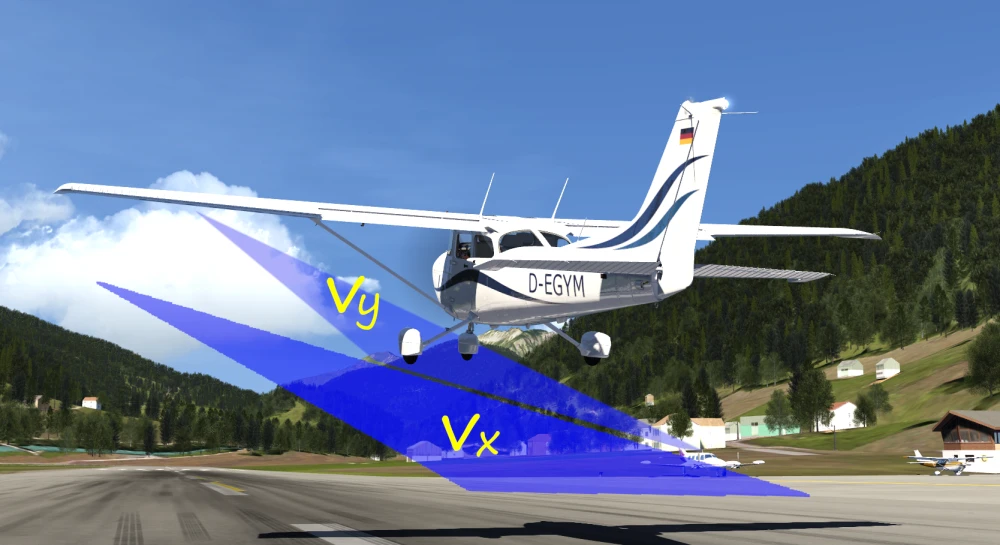
On a short runway or when there are obstacles at the end of the runway, the speed Vx may also be important in addition to Vy, as it represents the airspeed for the maximum climb angle of your aircraft. However, once you have cleared the end of the runway and any obstacles, you switch back to Vy in order to climb more efficiently.